U.S. Household Debt Not Higher Than Usual (STATISTA)
by Felix Richter,
Oct 8, 2026
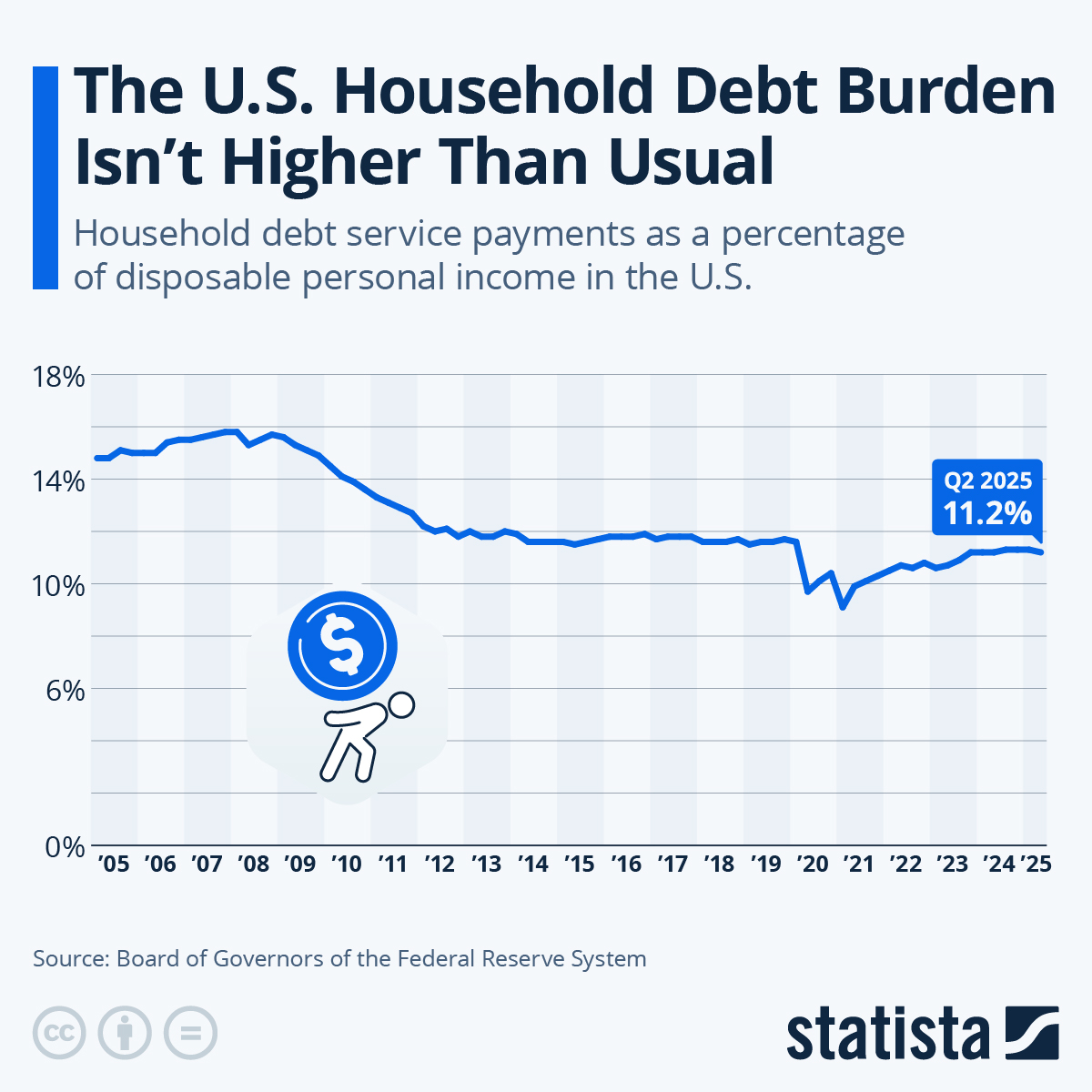
Even though household debt in the U.S. is at a record high of $18.8 trillion and many families are struggling to cope with high prices of everyday essentials, Americans aren’t drowning in debt. In fact, the household debt burden, i.e. the average household’s debt service payments as a percentage of disposable income, is lower than it's been for most of the past two decades.
In Q2 2026, American households used 11.1 percent of their disposable income to service their debts. That’s down from nearly 16 percent amid the financial crisis in 2008 and from an average of 12.1 percent between 2010 and 2019. And while the debt burden has gradually increased from 9.1 percent in Q1 2021, that was a historic low caused by many Americans using Covid stimulus payments to pay off debt and others temporarily lowering their payment obligations by taking advantage of loan forbearance programs.
Looking back further than 2005, the current rate of 11.1 percent is nothing out of the ordinary, either. Between 1980 and 2004, the household debt burden averaged 11.3 percent, and that’s using an old methodology that consistently delivered lower estimates than the methodology applied since 2005.
 You will find more infographics at Statista