The U.S. Runs on Non-Renewable Products (STATISTA)
by Katharina Buchholz,
Nov 27, 2026
On today's Black Friday – one of the busiest shopping days of the year – environmentalists encourage people to instead pause their spending for 24 hours in protest of excessive consumerism. Buy Nothing Day, championed by artist Ted Dave and anticorporate magazine Adbusters, raises awareness of the magnitude of resource use in the United States and the world as a whole.
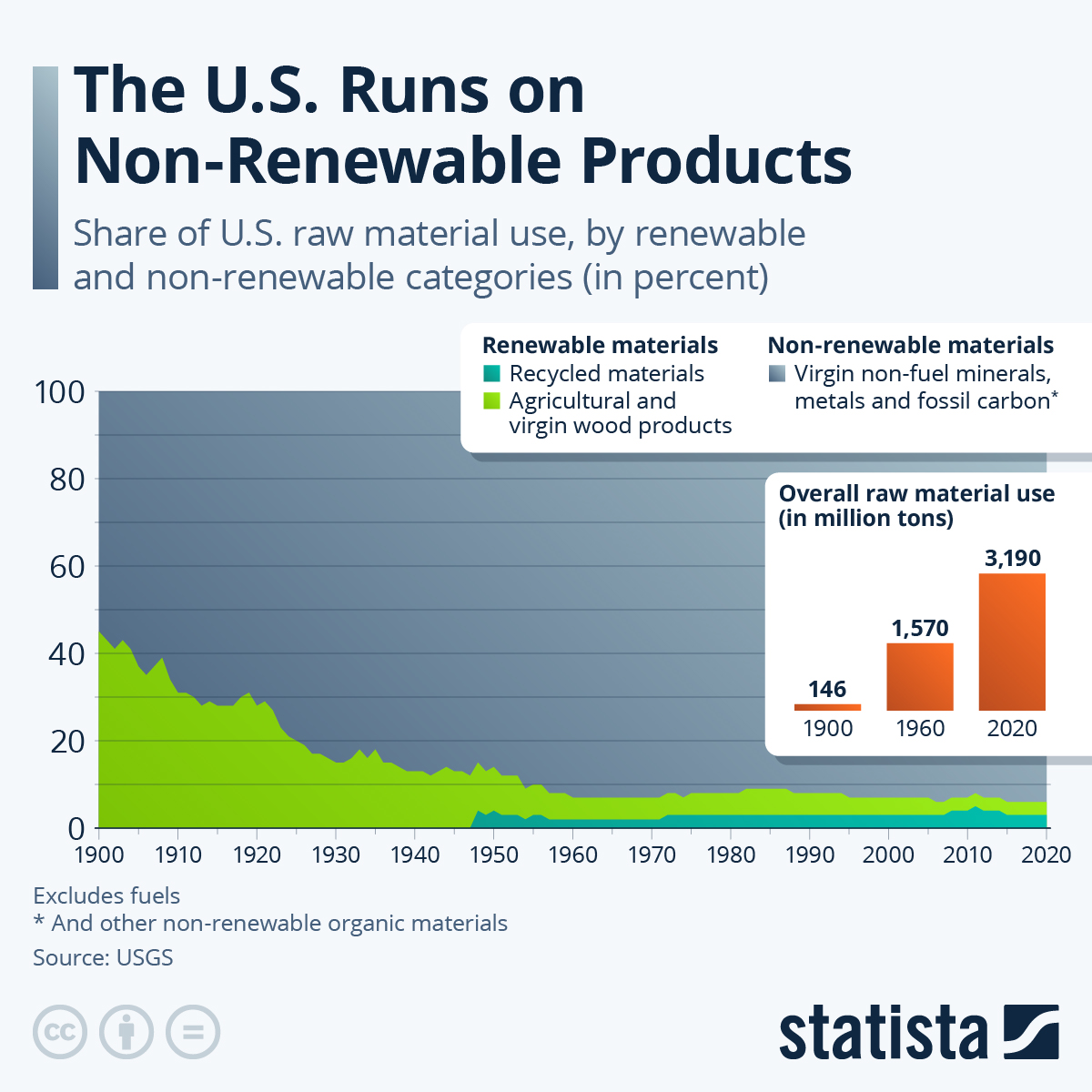
Raw materials used in the U.S. were 94 percent non-renewable as of 2020, meaning that the things that Americans build and buy are predominantly made of freshly extracted minerals, metals and fossil carbons, like oil or coal. The raw materials definition excludes fuels. The graph shows that around the turn of the 20th century, renewable resources still played a much larger role in U.S. raw material use, as more things were made from plant material and wood opposite concrete, metals and plastics. The U.S. Geological Survey estimates that American raw material use in the year 1900 still consisted of 45 percent agricultural and wood products (which can be regrown).
The data also shows that the recycling of materials like paper and metals, which made quick gains in the late 1940s, has hardly had an impact of the high share of non-renewable and virgin material sources used in the United States. In 1948, recycled materials already made up 4 percent of U.S. resource use, the equivalent of 30 million tons. In 2020, 100 million tons of recycled materials entering the resource stream only amounted to 3 percent of raw material use due to other categories growing faster, in particular non-renewable materials.
Driven by virgin minerals, metals and non-fuel carbons, U.S. resource consumption rose from just 146 million tons in the year 1900 to almost 3.2 billion tons in 2020.
 You will find more infographics at Statista