Old Age Dependency: UN Projections
Statista: Old-Age Dependency in Selected Countries
The Growing Burden of Old-Age Dependency
Anna Fleck
May 15, 2026
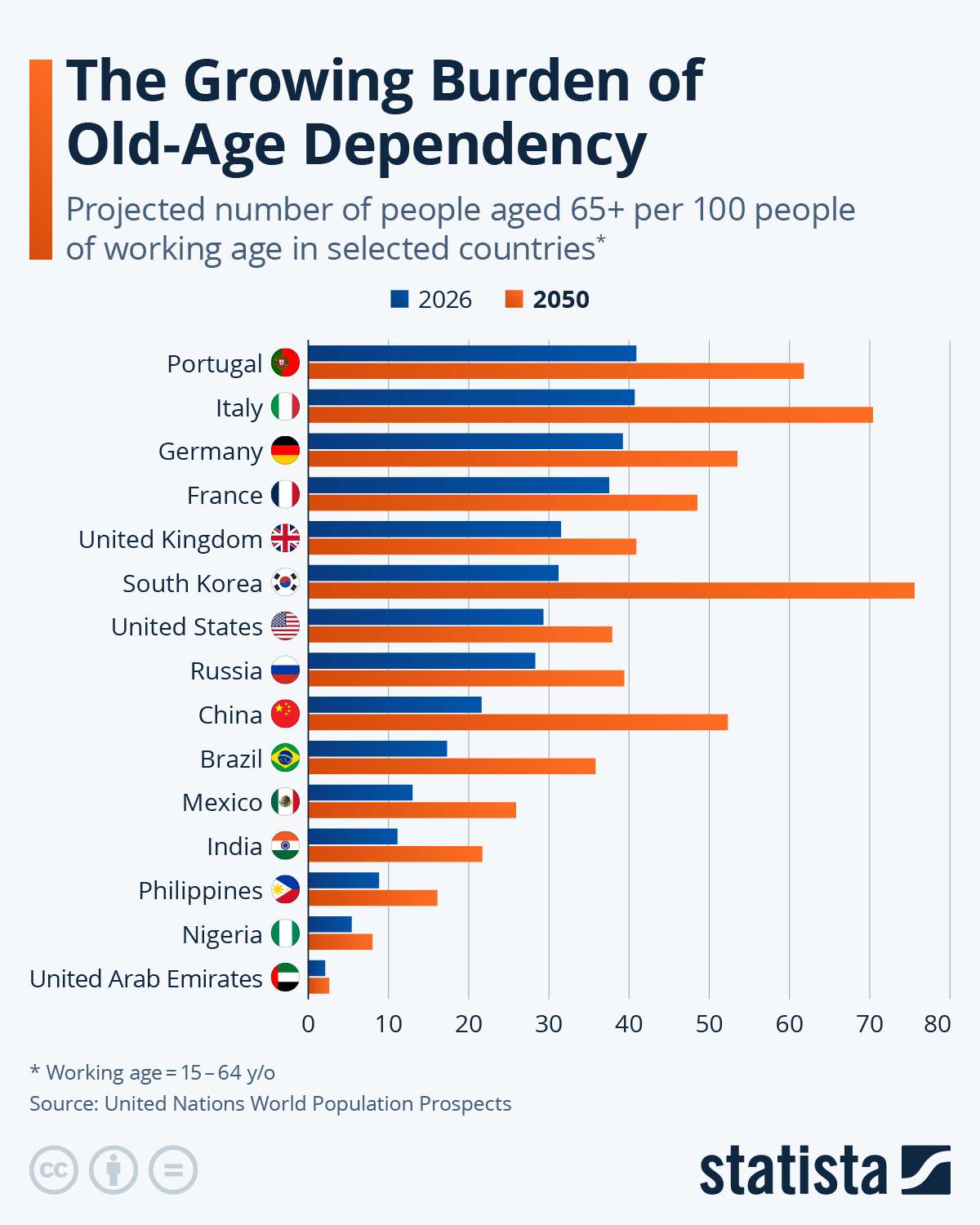
Many countries around the world are facing a rapidly rising old-age dependency ratio, according to projections published in the UN’s World Population Prospects 2024. This indicator measures the number of people aged 65 and older relative to the working-age population (between 15 and 64 years old).
South Korea is expected to experience a particularly steep increase, with the number of people aged 65 and over per 100 working-age adults projected to jump from 31.2 in 2026 to 75.6 by 2050. Italy is also forecast to see a dramatic rise, climbing from 40.7 to 70.4. These figures underscore the accelerating pace of global population ageing, which will result in a growing economic burden on shrinking workforces.
Established industrial economies such as the United States are projected to age more gradually, with the old-age dependency ratio rising from 29.3 to 37.9 over the same period. By comparison, China is expected to undergo a particularly rapid demographic shift, with its ratio more than doubling from 21.6 to 52.3. India and several younger emerging economies are forecast to remain comparatively youthful despite moderate increases.
These UN projections are based on certain trends in birth rates, life expectancy and migration. If these trends continue, ageing populations are likely to put increasing pressure on labor markets, pension systems and public finances, requiring governments to adapt their policies to older populations. It's important to note that this data does not account for the fact that many people over the age of 65 are still working, and younger people will not all be working
 You will find more infographics at Statista
OTHER PERSPECTIVES
Anna Fleck at Statista did an earlier post (Sep 14, 2023) below on the ratio of persons 65 and over per hundred persons of the working age population. That post is archived on this blog, and its data will be used in this discussion.
In both cases her titles have been truncated to remove negative biases toward the elderly population. While the retirement crises are looming in the sense that the demographic changes are going to take place across many nations, at some people in this country see it as more of an opportunity to use the talents of the elderly rather than as a threat to the working age population.
In this post "The Growing Burden of Old Age Dependency" was simplified to "Old Age Dependency UN Projections." We should not define everyone who is not working in labor force as dependent. Besides paid work there is a whole world of unpaid work including housework, care of children and care of the elderly. Many elderly are involved in all of these. There is a large world of voluntary work in our churches and civic organizations. Many unemployed elderly are busy helping others there, helping not only the elderly but also those too busy with paid work.
These statistics are very important and likely very reliable. Since most of the people have already been born, statisticians are predicting when they will die. Short of unpredictable events such as wars and pandemics, that is relatively easy.
There are some predictions of migration involved. For example, if the United States reduces total immigration (both legal and illegal) it may have less working age persons if we presume that immigrants are less likely to be elderly. Bringing more young wage earners, (and therefore taxpayers) into this country to offset elderly persons who are not earning wages and probably paying less taxes may help solve this crisis.
Fleck does give us at least one caution about these statistics. "It's important to note that this data does not account for the fact that many people over the age of 65 are still working, and younger people will not all be working.
Retirement age varies from country to county and access to jobs for people in the age group 55-64 varies from country to county. These are important variables in shaping the environment of the elderly The economic practices and government policies may help some nations and hinder others. Two posts with data from Statista deals with these issues.